Summary
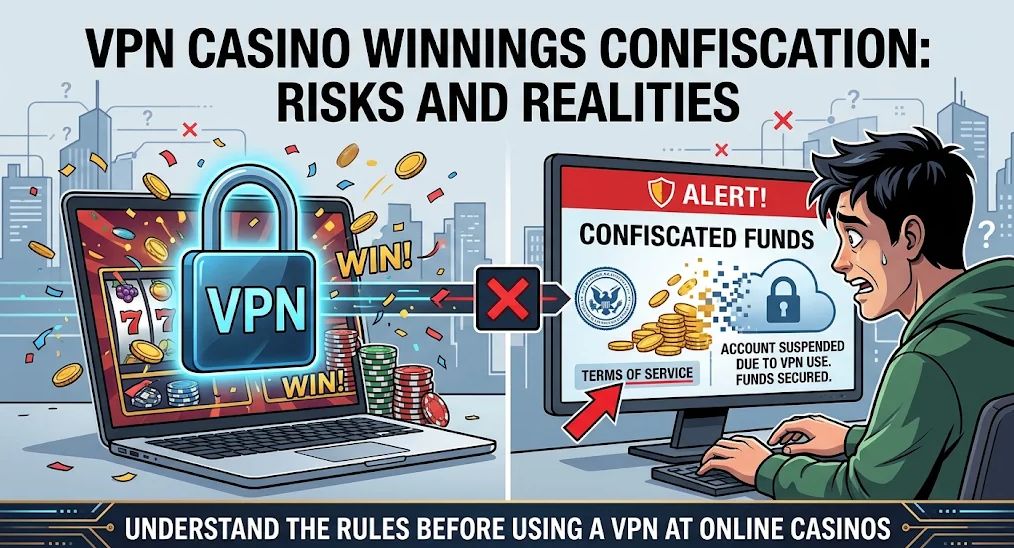
Using a VPN can lead an offshore casino to freeze withdrawals or void winnings, especially if it conceals a restricted location. However, not every VPN connection automatically justifies confiscation.
- Terms matter: Check restrictions on VPNs, physical location, residency and accurate account information. Casino, game-provider and bonus rules can differ.
- KYC can expose inconsistencies: Identity documents, payment details and connection records may conflict. A successful deposit does not prove you are eligible to play or withdraw.
- Privacy is not permission: A VPN changes your connection’s visible IP address – not your physical location, identity or legal eligibility.
- Australians face additional risks: Operators cannot lawfully supply real-money online casino games to people physically present in Australia. An overseas licence does not provide Australian authorisation.
- A frozen withdrawal is not necessarily confiscation: Ask whether the account is under review, which clause allegedly applies and how deposits, winnings and bonuses are being treated.
- If a dispute arises: Stop depositing, preserve records, provide truthful verification and use the formal complaints process. Never pay an unexpected “release fee” or share a wallet recovery phrase.
The practical rule: if accessing a casino depends on hiding your location, do not assume your winnings will remain withdrawable.


Before You Use a VPN at an Offshore Casino: Terms, Verification and Payout Risks
Yes. Using a VPN can lead an offshore casino to suspend your account, reject a withdrawal or void winnings – particularly when it conceals a prohibited location or breaches an explicit contractual restriction.
But confiscation is not an automatic consequence of every VPN connection. The outcome depends on the operator’s terms, your actual eligibility, the evidence and the rules governing the dispute.
That distinction matters. A privacy tool is not inherently proof of fraud. Equally, a successful deposit does not establish that an operator has accepted your location or verified your right to play.
For Australians, there is an additional issue: operators cannot lawfully supply real-money online casino games to people physically present in Australia. A VPN does not change that position.
This guide explains how VPN use can become a withdrawal problem, what KYC checks reveal and how to respond if an offshore operator challenges your balance. It does not recommend location masking or ways to defeat verification.
The Short Answer: Privacy Is Not Permission
A VPN routes your internet connection through another server. The destination website generally sees that server’s IP address instead of the address normally associated with your connection.
That can support legitimate privacy needs. It does not change:
-
Your identity.
-
Your country of residence.
-
Where you are physically playing.
-
The operator’s restricted-country rules.
-
The legal status of the gambling service.
The contractual question is therefore not simply, “Was a VPN switched on?”
It is, “What did the terms prohibit, what happened, and what consequence can the operator legitimately apply?”
A player using an ordinary workplace VPN while otherwise eligible presents a different situation from someone selecting a foreign location to bypass a country restriction.
Both may trigger questions. They do not necessarily justify the same outcome.
What “Confiscated Winnings” Actually Means
Players often use “confiscated” to describe any inaccessible balance. Several different actions can sit behind that description.
| Operator action | What it means | What remains unresolved |
|---|---|---|
| Withdrawal pending | Payment has not been approved | Whether checks are routine or disputed |
| Account suspended | Access or activity is restricted | Whether the restriction is temporary |
| Winnings voided | The operator treats specified winnings as invalid | Which rule and transactions justify that decision |
| Deposit refund proposed | Some deposited funds may be returned | Whether all relevant funds are included |
| Account closed | The relationship is terminated | How the remaining balance will be handled |
A temporary review is not the same as a final decision to remove money.
Likewise, an offer to refund a deposit is not necessarily a complete resolution. Ask how the operator has separated deposits, winnings, bonuses and any deductions.
The first practical step is to obtain a written description of the action taken.
Why KYC Often Exposes the Problem
KYC, or know your customer, is the process used to verify who holds an account. Depending on the operator and applicable rules, checks can involve identity documents, address evidence, payment ownership and additional financial information.
An account can accumulate conflicting information before those checks are completed.
For example:
-
Registration details identify an Australian resident.
-
Connection records suggest another country.
-
A payment method belongs to the Australian account holder.
-
Withdrawal documents confirm an Australian address.
-
The operator investigates whether access restrictions were bypassed.
No single inconsistency automatically proves deception. People travel, use business networks and change addresses.
However, a mismatch can give an operator grounds to ask questions before approving a payout.
Why depositing successfully proves very little
Payment authorisation and gambling eligibility are separate checks.
A payment processor may approve a transaction without deciding whether the customer complies with the casino’s location rules. The casino may investigate only later.
That sequencing can be unfair or poorly controlled, but it does not make the original deposit a reliable eligibility certificate.
ACMA specifically warns that illegal offshore operators may accept deposits and subsequently prevent customers from accessing winnings.
The Contract Clauses That Matter Most
The VPN rule may appear across several policies rather than under one obvious heading.
Read the general terms, restricted-country list, verification policy, withdrawal conditions and relevant promotional rules together.
Restricted jurisdictions
These clauses define where the service is unavailable.
Some distinguish between residence and physical presence. Others restrict both.
An overseas citizen visiting Australia may therefore remain ineligible even if their permanent address is elsewhere. Conversely, moving a connection overseas does not establish that the player has travelled.
Accurate account information
Operators commonly require complete, accurate and current information.
False addresses or misleading residency statements create a separate issue from VPN use. Even if the VPN policy is ambiguous, inaccurate registration details can provide another contractual basis for action.
Circumvention restrictions
These clauses target attempts to bypass geographic or other access controls.
They may mention VPNs, proxies or similar tools specifically. Some prohibit the technology broadly; others focus on using it to misrepresent location.
That wording matters.
Account sanctions and balance treatment
A clause identifying prohibited conduct should be distinguished from a clause specifying the consequences.
Ask whether the terms explain:
-
When an account can be suspended.
-
Which bets may be voided.
-
How deposited funds are treated.
-
Whether the operator must explain its decision.
-
What complaint process applies.
A vague reference to “security” does not answer those questions.
A Real Example: What Published Offshore Terms Say
Stake’s published terms provide a concrete example – not a recommendation.
Its prohibited-jurisdiction provisions include Australia. They also state that manipulating location information or providing misleading residency information to circumvent restrictions breaches the agreement.
The VPN provision addresses attempts to manipulate a real location through VPNs, proxies or similar services with the intention of bypassing geographic restrictions.
Separately, its account-information provisions state that incomplete, inaccurate or outdated information can lead to suspension and potentially invalid deposits and voided related winnings.
These are distinct contractual routes. A dispute might involve location circumvention, inaccurate account details or both.
The lesson is not that every offshore casino uses identical wording. It is that “VPN-friendly” summaries can overlook the restrictions that become decisive during withdrawal review.
Always assess the exact domain and current agreement. A brand name alone does not identify the governing contract.
Casino Access and Game Access Are Different
An operator can impose one set of country restrictions while a game supplier imposes another.
Stake’s published provider policy illustrates this distinction: its supplier restrictions include separate geographic limitations for certain games and branded titles.
Therefore, reaching a casino lobby does not necessarily establish eligibility to play every available game.
The same distinction can apply to promotions. A general account may be permitted while a particular promotion is unavailable in the player’s jurisdiction.
| Eligibility layer | Question to ask |
|---|---|
| Local law | Can the service lawfully be supplied where I am? |
| Operator terms | Does this operator accept my residence and physical location? |
| Game restrictions | Is this title available in that jurisdiction? |
| Promotion rules | Am I eligible for this specific offer? |
A VPN does not resolve any of these questions. It may merely obscure the information used to assess them.
Can a Casino Detect Every VPN?
No operator can responsibly promise perfect detection in every case.
Nor should a player assume that one successful login establishes that their connection is acceptable.
The important point is broader: location reviews do not depend solely on detecting a VPN application.
Operators can compare information supplied through registration, verification, payment ownership and account activity. Their precise tools and decision rules vary.
An IP address is evidence, not identity
A foreign-looking IP address does not conclusively prove that a person is abroad. A shared connection does not conclusively prove multiple accounts.
This matters when challenging an inaccurate decision.
Ask the operator to explain the alleged breach rather than accepting a general statement that “the system detected something”.
However, do not invent an alternative explanation. A truthful account of travel or ordinary privacy use is more useful than a story designed to reconcile incompatible records.
What If You Left Your VPN On Accidentally?
An accidental connection does not automatically produce a right to confiscate the entire balance.
But it can still require explanation, especially where the terms prohibit VPN use broadly.
Stop gambling while the issue is clarified. Record when you noticed the connection and provide an accurate account if asked.
Do not:
-
Alter your address to match the VPN server.
-
Create another account.
-
Submit somebody else’s documents.
-
Delete records relevant to the dispute.
-
Continue betting to make the balance look different.
Switching the VPN off prevents further VPN-connected sessions. It does not erase previous activity or resolve a restricted-location problem.
For someone physically in Australia, the underlying offshore online casino issue remains regardless of whether the original VPN connection was accidental.
Does Customer Support Approval Protect You?
A support message can be useful evidence, but its scope matters.
“VPNs are allowed” may mean ordinary privacy use by otherwise eligible customers. It does not necessarily mean restricted jurisdictions are accepted.
Likewise, “you can withdraw after verification” is not a definitive confirmation that every account condition has been satisfied.
Useful written clarification should address:
-
Your actual country of residence.
-
Where you will physically access the service.
-
The relevant payment method.
-
The specific restriction being discussed.
Even explicit support approval cannot override applicable law.
If support contradicts published terms, do not treat that contradiction as a safe basis for depositing. Request clarification from the operator’s compliance team.
No-KYC and Crypto Do Not Remove the Risk
“No KYC” is often interpreted as a promise that identity checks will never occur.
That interpretation is unsafe.
An operator may reserve verification rights elsewhere in its terms. Checks may arise later because of account concerns, transaction reviews or applicable obligations.
Cryptocurrency does not change that.
A blockchain transfer can deliver funds to the operator without establishing the player’s eligibility or creating an enforceable promise of immediate withdrawal.
Once funds enter a custodial casino account, the displayed balance depends on the operator releasing them.
A wallet transaction identifier proves that a transfer occurred. It does not prove the casino owes a particular gambling balance or has approved a payout.
Neither crypto nor a privacy tool should be treated as a substitute for withdrawal rights.
Are Confiscation Clauses Always Enforceable?
No. Writing a power into terms does not automatically make every exercise of that power fair or legally enforceable.
The answer depends on the governing law, licensing framework, contract wording and facts.
The distinction between deposited money, cash winnings and promotional funds can also matter.
For comparison, UK Gambling Commission guidance restricts its licensees from confiscating deposit balances simply because a customer cannot satisfy identity-verification requests. It also says withdrawals must not trigger information requests that could reasonably have been made earlier.
Those are useful fairness benchmarks. They are not universal rules automatically binding every offshore casino serving Australians.
Three questions to separate
-
Did the operator identify a contractual breach?
-
Does the claimed sanction follow from that breach?
-
Can the sanction be challenged under the applicable legal framework?
An operator’s decision answers none of these conclusively by itself.
Equally, calling a term unfair does not guarantee practical recovery from an overseas business.
Why Australians Have a Weaker Safety Net
Australia prohibits providers from supplying real-money online casino services, including online pokies and casino-style table games, to people physically present in the country.
A foreign licence does not create Australian authorisation.
ACMA warns that customers using illegal offshore gambling services do not receive the same protection as customers of licensed services. Australian regulators cannot resolve withheld-winnings disputes in the same way players might expect from a domestic licensing relationship.
That creates two separate risks:
-
Contractual risk: the operator invokes its location or VPN rules.
-
Recovery risk: the player has limited practical options to challenge the decision.
Reporting an operator can support enforcement. It should not be confused with a guaranteed repayment process.
For substantial disputed balances, independent legal advice may help assess whether an overseas complaint or legal claim is realistic.
What to Do If Your Withdrawal Is Frozen
Act methodically. More deposits and more gameplay rarely clarify a dispute.
1. Preserve the evidence
Save your balance, transaction history, withdrawal request, emails and support conversations.
Record the relevant dates and the terms available to you. Distinguish a copy saved during registration from a current version obtained later.
2. Request the exact grounds
Ask for the clause number, alleged conduct, relevant period and proposed financial consequence.
Clarify whether the account is under review or whether a final decision has been made.
3. Provide truthful verification
Use the operator’s verified secure channel. Do not send identity documents to unsolicited social-media accounts.
A legitimate wallet verification request should not require your private key or recovery phrase.
4. Submit a formal complaint
Follow the published complaints procedure and request a reference number.
Set out a concise timeline. Attach relevant evidence rather than sending repeated contradictory messages.
5. Check external escalation
Verify the operator’s licence and the regulator’s actual remit. Some disputes may go to an approved alternative dispute resolution service after the internal process ends.
Deadlines, claim limits and eligibility conditions vary.
6. Seek appropriate outside help
ACMA identifies independent legal advice, complaints to the ACCC and contact with the relevant licensing authority as possible avenues.
None guarantees recovery.
For an unauthorised payment, contact your bank promptly and explain the facts accurately. Do not describe an authorised gambling deposit as fraud merely because a withdrawal dispute followed.
A Complaint Message You Can Adapt
Please confirm whether my withdrawal is pending verification, suspended or finally refused.
Identify the exact contractual clause relied on, the alleged breach and the dates concerned.
Please provide a breakdown of deposited funds, winnings, promotional funds and proposed deductions.
I request a written explanation of the decision, the applicable terms version and details of your formal complaints and external dispute-resolution procedures.
I will provide accurate verification information through your official secure channel.
This wording does not concede or deny facts you have not established. It asks the operator to make its position clear.
Warning Signs During a Dispute
Be cautious if the operator:
-
Demands another deposit to release winnings.
-
Requests payment to an employee’s personal wallet.
-
Refuses to identify any relevant clause.
-
Changes its explanation repeatedly.
-
Asks for remote access to your device.
-
Requests a crypto recovery phrase.
-
Directs you to an unsolicited recovery agent.
A VPN allegation should not become a reason to surrender more money or sensitive credentials.
Preserve the request and seek independent guidance before acting.
Frequently Asked Questions
Will every casino confiscate winnings for VPN use?
No. Policies differ. The greatest contractual risk arises when VPN use conceals a restricted location or violates an express rule.
Can I resolve the problem by turning my VPN off?
Not necessarily. That changes future connections, not historical activity, account information or physical eligibility.
Does a successful small withdrawal prove I am safe?
No. It confirms only that a particular withdrawal was processed. Later reviews or larger disputes can involve additional checks.
Is a VPN itself illegal in Australia?
Ordinary VPN use is not the same issue as unlawful gambling supply or breach of a casino contract. The relevant risks concern how the tool is used and which service is accessed.
Can a regulator force an offshore casino to pay?
That depends on its jurisdiction, authority and the dispute. Do not assume an Australian regulator can recover an offshore casino balance.
Final Verdict
A VPN can become the basis for withheld or voided winnings, especially when it is used to conceal a prohibited location. But the operator should still identify the rule, evidence and financial consequence rather than treating every VPN connection as automatic proof of fraud.
For Australians, the underlying issue is more serious than a technical setting: offshore online casino access does not create Australian authorisation or dependable recovery rights.
If a dispute occurs, stop adding exposure, preserve records and pursue the formal complaint process truthfully.
The safest principle is simple: if eligibility depends on hiding where you are, the withdrawal arrangement is already unreliable.
Sources
- ACMA: Illegal offshore gambling, withheld winnings and recovery options
- Stake: Published terms on prohibited jurisdictions, location manipulation and account information
- Stake: Separate game-provider jurisdiction restrictions
- Stake: Published complaints and alternative dispute-resolution procedure
- UK Gambling Commission: Identity verification and treatment of customer funds
- UK Gambling Commission: Fair terms, withdrawals and explanations of alleged breaches