Key Takeaways
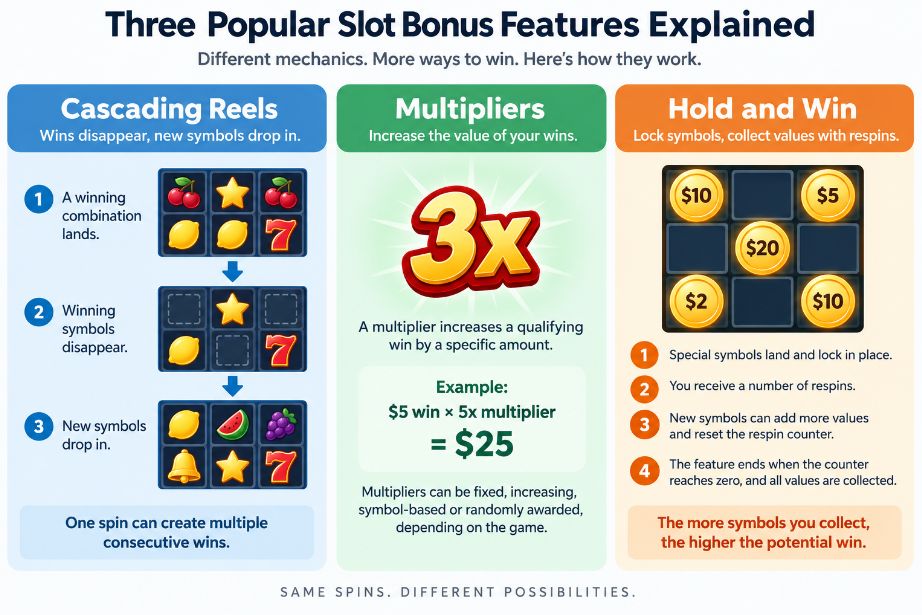
- Cascading reels remove winning symbols and replace them with new symbols, allowing additional wins from the same spin.
- Multipliers increase qualifying wins by a specific value, such as 2x, 5x, or 10x.
- Hold and Win features lock special symbols with cash values and use respins to build a final prize.
- Cascades and multipliers can work together, with multipliers sometimes increasing after consecutive wins.
- Hold and Win rounds commonly start when a required number of special symbols lands.
- Respins may reset when another qualifying symbol appears, extending the bonus round.
- RTP and volatility are separate from individual bonus mechanics and are important when comparing slots.
- A large multiplier or maximum win does not mean a slot will produce large wins frequently.
- Bonus features do not change the fundamental randomness of casino games or guarantee a profit.
- Always check the paytable to understand feature triggers, multiplier rules, respins, maximum wins and symbol values.
- The best slot feature depends on personal preference, bankroll and tolerance for volatility rather than the appearance of the bonus alone.
- Responsible gambling matters: set limits, avoid chasing losses and treat slot play as entertainment rather than a source of income.


Slot Bonus Features Explained: Cascades, Multipliers & Hold and Win
Modern online slots are no longer built around a simple spin-and-stop format. While the basic idea remains familiar, many of today’s most popular slot games use bonus mechanics to create additional ways to form wins, increase payouts, or extend a feature round.
Three mechanics appear particularly often across contemporary slot games: cascading reels, multipliers, and Hold and Win features. Each mechanic changes the way a spin works, but they do so in very different ways.
Understanding how these features operate is useful for anyone who plays online slots. It can make game rules easier to follow, help players compare different titles, and provide a clearer picture of how potential payouts are generated.
This guide breaks down each mechanic step by step using simple diagrams and examples. The aim is not to suggest that one feature guarantees better results than another. Slot outcomes are determined by the game’s mathematical design and random number generation. Instead, the focus is on understanding what actually happens during a spin.
What Are Bonus Features in Online Slots?
A bonus feature is a special game mechanic that changes the normal base-game process.
A traditional slot may follow a straightforward sequence:
Bet → Spin → Reels stop → Winning combinations are paid
Modern games can add several additional stages:
Bet → Spin → Win → Feature activates → Reels change → New win → Multiplier applies → Feature ends
These mechanics are usually designed to make individual spins more dynamic. A single winning combination can trigger another event rather than immediately ending the spin.
Common slot features include:
- Cascading reels
- Multipliers
- Free spins
- Hold and Win rounds
- Expanding wilds
- Sticky wilds
- Bonus symbols
- Pick-and-win games
- Respin features
- Increasing multipliers
- Progressive jackpots
The important point is that these features are part of the game’s rules. They do not operate independently from the slot’s mathematical model.
A game with a large multiplier does not automatically have better value than a game without one. A Hold and Win slot may offer large advertised prizes while still producing relatively infrequent major wins.
The feature needs to be considered together with the game’s volatility, return to player percentage, hit frequency, maximum win and overall mathematical structure.
Cascading Reels Explained
Cascading reels are also known as avalanche reels, tumbling reels, or cluster-style mechanics, depending on the game’s design.
The basic principle is simple:
A winning combination disappears → symbols fall into the empty positions → new symbols arrive → another win may occur
This means one paid spin can contain several consecutive winning events.
Simple Cascading Diagram
Imagine a 5×3 slot grid:
A   B   C   D   E
B   C   A   B   C
D   A   B   C   A
Suppose the symbols marked B create a winning combination.
The winning symbols disappear:
A   -   C   D   E
-   C   A   -   C
D   A   -   C   A
The remaining symbols fall downward:
A   -   -   D   -
-   -   A   -   -
D   C   C   C   A
New symbols then appear in the empty spaces:
X   Y   Z   D   Q
A   B   A   C   C
D   C   C   C   A
The new arrangement is checked for another win.
If another winning combination appears, the process repeats.
How a Cascade Works Step by Step
The exact rules vary between games, but a typical sequence looks like this:
Step 1: The player spins
The player selects a stake and starts the spin.
Step 2: The reels produce a result
The game evaluates the symbols according to its paytable or winning rules.
Step 3: A winning combination is identified
For example, three or more matching symbols may form a win.
Step 4: Winning symbols disappear
Instead of stopping immediately, the game removes the symbols involved in the win.
Step 5: Symbols fall
Remaining symbols move downward into the empty positions.
Step 6: New symbols appear
Fresh symbols enter from the top or another designated direction.
Step 7: The game checks again
If the new layout creates another winning combination, another cascade begins.
Step 8: The sequence ends
When no additional winning combination is produced, the cascade finishes and the spin is complete.
This can result in a chain such as:
Initial Spin
     ↓
Win #1
     ↓
Cascade
     ↓
Win #2
     ↓
Cascade
     ↓
Win #3
     ↓
No More Wins
     ↓
Spin Ends
This is one reason cascading slots can feel more active than traditional reel games.
Why Cascading Slots Feel Different
The main difference is that a single spin can produce multiple consecutive outcomes.
In a conventional slot, the player may see one result and immediately move to the next spin.
With cascading reels, the game can continue resolving after the initial winning combination.
This creates a visual chain reaction.
However, it is important not to confuse the number of animations with the amount of money won.
For example:
Spin Cost: $1

Cascade 1: +$0.50
Cascade 2: +$0.75
Cascade 3: +$1.25

Total Win: $2.50
The player still paid $1 for the original spin. The additional cascades do not represent separate paid spins unless the specific game rules say otherwise.
Cascading Reels and Multipliers
Cascading mechanics become especially interesting when combined with multipliers.
Some games apply a multiplier to individual cascade wins. Others increase the multiplier after each consecutive cascade.
A simplified example might look like this:
Cascade 1
Win = $1
Multiplier = 1x
Total = $1

Cascade 2
Win = $1
Multiplier = 2x
Total = $2

Cascade 3
Win = $1
Multiplier = 3x
Total = $3
The combined result would be:
$1 + $2 + $3 = $6
The actual rules differ significantly between games, so players should always check the paytable.
Some slots reset the multiplier after a certain event. Others keep it active throughout a feature. Some use a maximum multiplier, while others allow it to grow until the feature ends.
Understanding Multipliers
A multiplier is a number applied to a qualifying win.
Common examples include:
- 2x
- 3x
- 5x
- 10x
- 25x
- 50x
- 100x
- 500x or higher in some high-volatility games
The calculation itself is straightforward.
If a qualifying win is worth $5 and a 10x multiplier applies:
$5 × 10 = $50The important question is not how multiplication works. It is when the multiplier applies.
That information is found in the game’s rules.
Different Types of Slot Multipliers
Fixed Multipliers
A fixed multiplier remains at the same value.
Example:
Winning combination = $2
Multiplier = 5x

$2 × 5 = $10
Every qualifying win receives the same multiplier.
Increasing Multipliers
The multiplier can rise as a feature progresses.
Example:
1st cascade → 2x
2nd cascade → 3x
3rd cascade → 4x
4th cascade → 5x
This design is often associated with cascading mechanics.
Symbol Multipliers
Certain symbols may carry individual multiplier values.
For example:
Gold Symbol = 5x
Red Symbol = 10x
Blue Symbol = 25x
The rules determine whether these values apply to individual symbols, complete combinations, or feature totals.
Random Multipliers
Some games randomly assign multiplier values during a bonus round.
A player might see:
Multiplier revealed:
25x
The game then determines which eligible win receives the multiplier.
Multipliers Are Not the Same as Higher RTP
This distinction is important.
A slot can advertise a maximum multiplier of 100x, 500x, or even more without guaranteeing that players will frequently receive that multiplier.
The multiplier is part of the game’s potential payout structure.
The RTP, or return to player, is a separate mathematical measure. It represents the theoretical long-term percentage of wagered money returned through wins under the game’s specified configuration.
For example, a theoretical RTP of 96% does not mean a player will receive exactly $96 after wagering $100.
Short-term results can be dramatically different.
A player could wager $100 and finish with $20, $150, or potentially much more. The theoretical RTP is calculated across a very large number of game outcomes.
Hold and Win Explained
Hold and Win is another popular slot mechanic.
It is commonly associated with games featuring special coin, cash, orb, token, or money symbols.
The feature usually begins when enough special symbols land during a qualifying spin.
Instead of simply paying the values immediately, the symbols may become locked in place while the game awards additional respins.
A simplified version looks like this:
SPECIAL SYMBOLS LAND
        ↓
BONUS TRIGGER
        ↓
RESPINS BEGIN
        ↓
NEW SPECIAL SYMBOL?
     /
   YES        NO
    ↓          ↓
LOCK IT     RESPIN COUNTER
            DECREASES
        ↓
COUNTER REACHES ZERO
        ↓
FEATURE ENDS
        ↓
VALUES ARE ADDED
The exact trigger requirements vary from one slot to another.
Hold and Win Step by Step
Step 1: Special symbols appear
During the base game, special symbols may land.
These could display monetary values such as:
$1
$5
$10
$25
$50
Some games use values based on the player’s bet.
Step 2: The feature is triggered
A specific number of special symbols may be required.
For example:
3 or more special symbols = Hold and WinThis is only an example. Actual requirements differ between games.
Step 3: The symbols become locked
The qualifying symbols remain fixed on the grid.
Step 4: Respins begin
The player receives a limited number of respins.
A common structure is three respins.
RESPINS: 3

New symbol lands
↓
RESPINS RESET TO 3
If no qualifying symbol appears:
Respins: 3
↓
2
↓
1
↓
0
↓
Feature Ends
If a new special symbol lands, the counter may reset.
3 respins
   ↓
new symbol
   ↓
3 respins
   ↓
new symbol
   ↓
3 respins
This is one of the defining characteristics of many Hold and Win games.
Hold and Win Grid Example
Consider a simplified 5×3 feature:
+----+----+----+----+----+
|    | $5 |    |    | $2 |
+----+----+----+----+----+
|    |    | $10|    |    |
+----+----+----+----+----+
| $1 |    |    | $25|    |
+----+----+----+----+----+
The locked values are:
$5 + $2 + $10 + $1 + $25 = $43
A new special symbol could then land:
+----+----+----+----+----+
| $7 | $5 |    |    | $2 |
+----+----+----+----+----+
|    |    | $10|    |    |
+----+----+----+----+----+
| $1 |    |    | $25|    |
+----+----+----+----+----+
The new total becomes:
$50
The feature can continue until the respin counter expires or another game-specific condition is reached.
Why Hold and Win Games Are Popular
Hold and Win mechanics are easy to understand visually.
Players can see the values accumulating on the screen.
The feature also creates a clear sense of progression:
More symbols
      ↓
More occupied positions
      ↓
Higher potential total
      ↓
Final collection
Some games introduce additional mechanics, such as:
- Mystery symbols
- Collect symbols
- Jackpot symbols
- Mini jackpots
- Major jackpots
- Grand jackpots
- Multipliers
- Special bonus positions
- Expanding grids
These additions can make one Hold and Win game behave very differently from another.
Hold and Win Does Not Mean Guaranteed Profit
The visual accumulation of cash values can make the feature particularly exciting, but it is still governed by the game’s underlying mathematics.
A feature can finish with only a modest payout.
For example:
$1 + $2 + $1 + $5 = $9A different feature could produce:
$5 + $10 + $25 + $50 + $100 = $190The second result is larger, but the possibility of a higher collection does not mean that it will happen regularly.
Players should therefore examine the game’s volatility, RTP, maximum win and bonus rules rather than judging a slot purely by its visual feature.
Cascades vs Multipliers vs Hold and Win
These three mechanics can be compared by asking what each one changes.
| Feature | Main Function | Typical Gameplay |
|---|---|---|
| Cascading Reels | Removes winning symbols and creates new combinations | Chain reactions |
| Multipliers | Increases qualifying payouts | Larger individual wins |
| Hold and Win | Locks special symbols and awards respins | Accumulating values |
| Free Spins | Provides additional spins under special rules | Extended bonus round |
| Expanding Wilds | Changes reel coverage | Larger winning combinations |
The mechanics can also appear together.
A slot might use:
Cascade
   ↓
Winning symbols disappear
   ↓
Multiplier increases
   ↓
New symbols fall
   ↓
Another win
   ↓
Higher multiplier
Another game might combine Hold and Win with multipliers:
Cash Symbol
    ↓
Locked
    ↓
Multiplier Symbol Appears
    ↓
Eligible Values Increased
    ↓
Final Collection
This combination is becoming increasingly common in modern slot design.
How to Read a Slot’s Bonus Rules
Before playing a new slot, open the game’s information panel or paytable.
Look for the following information.
1. Feature Trigger
How does the bonus begin?
Examples include:
- Three bonus symbols
- Three or more special symbols
- A specific scatter combination
- A randomly triggered feature
2. Feature Duration
Does the feature last for:
- A fixed number of spins?
- Three respins?
- A sequence of cascades?
- Until no further win occurs?
3. Multiplier Rules
Find out:
- When the multiplier activates
- Which wins it affects
- Whether it increases
- Whether it resets
- Whether it has a maximum value
4. Symbol Values
For Hold and Win games, check whether special values are:
- Fixed
- Bet-dependent
- Random
- Multiplied
- Collected individually
- Combined into a feature total
5. Maximum Win
Some games advertise a maximum win expressed as a multiple of the stake.
For example:
Maximum Win = 5,000xThis does not mean a player should expect to reach that value. It represents the game’s stated maximum potential payout under its rules.
Volatility Matters
Bonus features should always be considered alongside volatility.
A low-volatility slot generally aims for more frequent, smaller outcomes.
A high-volatility slot can produce larger wins but may also produce longer periods without significant payouts.
Two games can have similar RTP figures but feel completely different because their volatility and feature structures differ.
For example:
Slot A
Frequent small wins
Lower maximum win
Lower volatility

Slot B
Less frequent wins
Large bonus potential
Higher volatility
Neither description automatically makes one game better.
The better choice depends on the player’s preferences, bankroll and tolerance for fluctuations.
A Practical Example: Combining All Three Mechanics
Imagine a fictional slot called Treasure Cascade.
Its feature system works like this:
BASE SPIN
   ↓
Winning symbols
   ↓
Cascade
   ↓
New symbols appear
   ↓
Another win?
   ↓
Multiplier increases
   ↓
Special coins appear
   ↓
Hold and Win triggered
During a feature:
Win #1 = $2
Multiplier = 1x

Win #2 = $3
Multiplier = 2x

Win #3 = $4
Multiplier = 3x
The calculated wins would be:
$2 × 1 = $2
$3 × 2 = $6
$4 × 3 = $12

Feature subtotal = $20
Then the Hold and Win portion begins:
$5 + $10 + $2 + $25Total Hold and Win collection:
$42
Overall feature result:
$20 + $42 = $62
This example demonstrates how several mechanics can interact.
It does not represent a prediction of what a real slot will pay.
What Makes a Bonus Feature Good?
There is no single answer.
From a game-design perspective, a strong feature usually has three qualities:
Clear Rules
Players should be able to understand what triggered the feature and what happens next.
Meaningful Progression
The feature should give players a visible sense of development, such as:
More cascades
More multiplier
More locked symbols
More occupied positions
Mathematical Purpose
The feature should fit naturally into the game’s overall payout structure.
A spectacular-looking bonus can still have relatively modest average returns. Conversely, a simple mechanic can form an important part of a slot’s mathematical design.
Common Misunderstandings About Slot Features
“A cascade means the next win is more likely.”
Not necessarily.
The next outcome is still governed by the game’s programmed mathematics and random number generation.
“A bigger multiplier means the slot has a higher RTP.”
No.
A multiplier can increase the size of certain wins without directly telling you the game’s RTP.
“A nearly full Hold and Win grid is guaranteed to fill.”
No.
Unless the rules explicitly guarantee additional symbols, every new outcome remains subject to the game’s mechanics.
“A bonus feature means the slot is profitable.”
No.
Bonus features provide additional game mechanics and payout opportunities. They do not remove the inherent risk associated with gambling.
How to Compare Slots With These Features
If you are choosing between several online slots, consider more than the bonus animation.
A useful comparison checklist is:
RTP
↓
Volatility
↓
Maximum Win
↓
Hit Frequency
↓
Feature Trigger
↓
Multiplier Structure
↓
Bonus Frequency
↓
Bet Limits
↓
Game Rules
For example, a player who prefers frequent smaller results may look for a lower-volatility game.
Someone seeking greater potential payouts may prefer a high-volatility title, understanding that larger fluctuations are part of the experience.
The feature itself should be treated as one part of the overall evaluation.
Responsible Gambling and Bonus Features
The most important point about any casino game is that the outcome cannot be controlled by understanding its mechanics.
Knowing how cascading reels work does not make the next cascade more likely.
Understanding a 10x multiplier does not improve the underlying odds.
Knowing that a Hold and Win feature uses three respins does not make a special symbol more likely to land.
These features explain what happens after certain outcomes occur. They do not provide a reliable method for predicting those outcomes.
Players should:
- Set a gambling budget before playing.
- Avoid chasing losses.
- Never gamble money needed for essential expenses.
- Treat wins as uncertain rather than expected income.
- Take breaks during longer sessions.
- Check local gambling rules and age requirements.
- Use deposit, spending or session limits where available.
- Stop playing if gambling stops feeling recreational.
For anyone who finds gambling difficult to control, professional support and responsible gambling organizations can provide confidential assistance.
Final Verdict: Understanding the Mechanics Behind the Spin
Cascading reels, multipliers and Hold and Win features are three of the most recognizable mechanics in modern online slots.
Cascading reels extend a winning sequence by removing successful symbols and replacing them with new ones.
Multipliers increase eligible payouts according to the game’s rules.
Hold and Win mechanics lock special symbols and use respins to create an accumulating collection of values.
The real value of understanding these features is not predicting the next result. It is being able to read a slot’s rules accurately and understand why a particular bonus round produced a particular payout.
The simplest way to remember the differences is:
CASCADING
Win → Remove → Replace → Win Again

MULTIPLIER
Win × Multiplier = Larger Eligible Payout

HOLD AND WIN
Lock Values → Respin → Add Values → Collect
Modern slots can combine all three:
WIN
 ↓
CASCADE
 ↓
MULTIPLIER
 ↓
NEW WIN
 ↓
SPECIAL SYMBOL
 ↓
HOLD AND WIN
 ↓
RESPINS
 ↓
FINAL COLLECTION
That combination is one of the reasons contemporary slot games can feel much more interactive than traditional reel machines.
For players, however, the same fundamental principle remains: the feature explains the game’s mechanics, not the outcome. RTP, volatility, maximum win, wagering requirements where applicable, and the game’s complete rules are more useful when evaluating a slot than the visual excitement of a bonus feature alone.
A well-informed player should therefore approach bonus mechanics as part of the entertainment and game design, while keeping realistic expectations about variance and risk.
Understanding how the machine works is useful.
Expecting that knowledge to overcome randomness is not.