
Navigating the digital halls of online gambling in Australia can feel like trekking through the outback without a map. If you are an Aussie punter, you already know the deal: the local landscape is strictly limited to sports betting, racing, and lotteries. Real-money online pokies, roulette, blackjack, and live dealer streams are legally off-limits for domestic operators under the strict rules of the Interactive Gambling Act 2001 (IGA).
Because of this, millions of Australian players naturally turn their gaze over the horizon toward offshore casino platforms. These operators—typically registered in hub jurisdictions like Curaçao, Malta, Anjouan, or Kahnawake—are more than happy to roll out the red carpet for Aussie traffic, accepting Australian Dollars (AUD) and featuring payment routes like PayID, local bank transfers, and cryptocurrency.
But there is a massive speed bump that almost every punter hits eventually: KYC (Know Your Customer) verification.


You hit a nice feature drop on a top-tier slot, run your balance up to a clean three grand, head to the cashier tab, click “Withdraw,” and boom – a roadblock appears. The casino demands a high-resolution photo of your Australian passport or driver’s license, a utility bill showing your home address in Brisbane or Melbourne, and perhaps a selfie holding your payment card.
Understandably, this triggers instant anxiety. You might wonder: Is it safe to upload my personal data to a company based halfway across the world? What are they actually doing with my documents? And is there a legal, reliable way to bypass this entire headache altogether?
This comprehensive, no-nonsense review breaks down the realities of KYC at Aussie-facing offshore casinos. We will unpack exactly why these international sites demand your private details, detail what a typical verification pipeline looks like, and honestly evaluate the methods—such as crypto and no-ID platforms—frequently used by players trying to avoid it.
What is KYC Verification and Why Do Offshore Casinos Care?
To understand how to deal with KYC, you first have to understand why it exists. KYC stands for Know Your Customer. It is a mandatory compliance process that financial institutions, digital wallets, and online gambling platforms use to verify the true identity of their users.
Many punters mistakenly assume that offshore casinos implement KYC purely as a stalling tactic to avoid paying out winnings. While a few rogue, unlicenced operators certainly abuse the process to frustrate players into reversing their withdrawals, legitimate offshore brands enforce KYC to comply with stringent international regulatory frameworks.
Even though these sites operate outside the direct jurisdiction of Australian authorities like the Australian Communications and Media Authority (ACMA), they still have to answer to their own licensing bodies and global financial watchdogs.
The Twin Pillars: Anti-Money Laundering (AML) & Counter-Terrorism Financing (CTF)
The primary force driving global KYC protocols is the prevention of financial crime. International regulatory networks, led by organizations like the Financial Action Task Force (FATF), place immense pressure on digital gambling hubs to ensure their platforms are not utilized to clean dirty cash.
Without verification checks, an online casino could easily turn into a massive laundromat. A bad actor could deposit illicit cash via an anonymous channel, place a few low-risk wagers on baccarat or roulette, and then withdraw clean funds directly into a legitimate bank account. To stop this, regulatory frameworks force casinos to map every dollar back to a verifiable human being.
Regulatory Licensing Compliance
If an offshore casino wants to secure and maintain a reputable gaming license, it must play by the rules of its home regulator.
-
Curaçao Gaming Control Board (Gcb): The most common jurisdiction for Aussie-facing sites. Historically relaxed, Curaçao shifted to a centralized licensing structure with strict AML compliance demands.
-
Anjouan Gaming Authority: A rapidly growing regulatory hub for crypto-friendly operators that mandates basic corporate accountability and structured identity checks.
-
Malta Gaming Authority (MGA) & Isle of Man: The gold standards of offshore regulation. These bodies require incredibly thorough player verification, often triggering automated checks the moment a player deposits or reaches a cumulative withdrawal threshold (typically around €2,000).
Fraud Prevention and Preventing Underage Gambling
Beyond legal compliance, casinos use KYC to protect their own bottom lines. The industry loses millions every year to “bonus abusers” (players who illegally spin up dozens of duplicate accounts using fake names to claim welcome packages multiple times) and chargeback fraud (players losing money on a credit card and falsely claiming their card was stolen). Furthermore, identity checks ensure that minors are blocked from accessing real-money gambling products.
The Standard Verification Pipeline: What Documents Do You Actually Need?
If you choose to play at a standard fiat-currency offshore casino (one that relies heavily on credit cards, PayID, or traditional bank wires), you will inevitably be asked to clear a KYC check. This usually happens during your very first withdrawal request.
To ensure the process goes as smoothly as possible and doesn’t trap your funds in limbo for weeks, you should expect to provide documents across three specific categories.
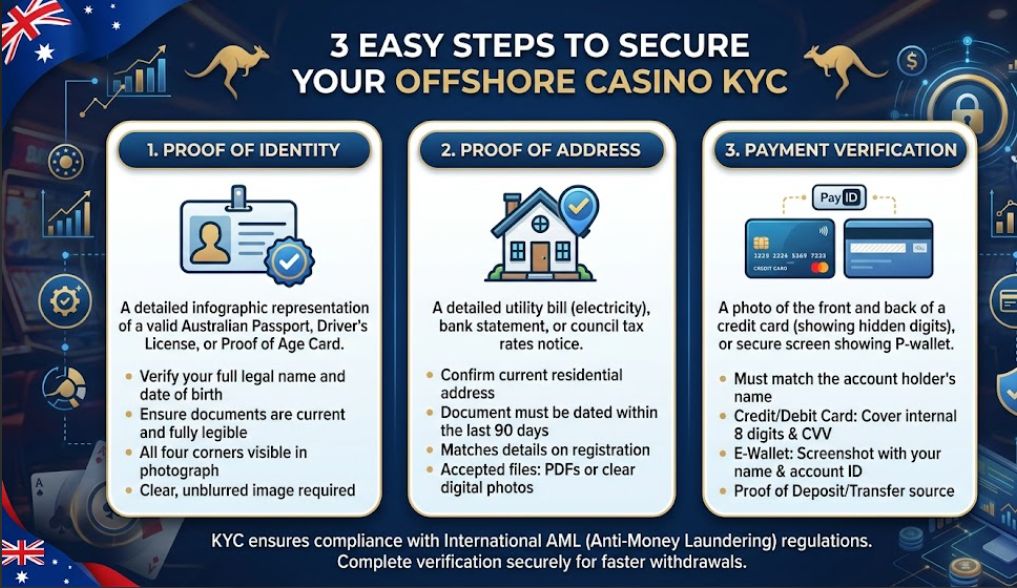
1. Proof of Identity (POI)
The casino must confirm your full legal name and date of birth. Accepted documents include:
-
A valid Australian Passport (photo page).
-
A current Australian Driver’s License (front and back).
-
A government-issued Proof of Age card.
Crucial tip for Aussies: The document must be completely visible. If any corner of the ID is cut off by the camera frame, or if your flash creates a glare over your birthdate, the security team’s automated document readers will instantly reject it.
2. Proof of Address (POA)
The operator needs to confirm that you actually reside where you claim to, ensuring you aren’t playing from a restricted jurisdiction (like the United States or certain European nations). Accepted documents include:
-
A utility bill (electricity, gas, water, or broadband internet).
-
A formal statement from a major Australian bank (CBA, ANZ, Westpac, NAB, etc.).
-
A current tenancy agreement or council rates notice.
Crucial tip for Aussies: This document must be dated within the last 90 days. Digital PDF downloads directly from your bank or utility portal are widely accepted, but old paper documents or mobile phone bills are frequently rejected.
3. Proof of Payment Method (POP)
This check ensures you are using your own money and aren’t playing with a compromised financial instrument.
-
Credit/Debit Cards: You must upload a photo of the physical card. For safety, you should always cover the internal eight digits of the long card number and completely obscure the 3-digit CVV code on the back.
-
E-Wallets / PayID: A screenshot of your account profile screen showing your registered name and account number/email.
-
Bank Transfers: A screenshot or PDF statement clearly showing your BSB, account number, and your name as the primary account holder.
Can KYC Be Avoided at Aussie-Facing Offshore Casinos?
This is the golden question for many Australian players. Whether due to legitimate privacy concerns, data breach fears (remembering the massive Optus and Medibank hacks on shore), or simply a desire for a fast, frictionless gaming experience, players want to know if they can skip the red tape.
The short answer is yes, but with massive caveats.
Let’s look closely at the realistic strategies, the operational loopholes, and the absolute myths surrounding the avoidance of KYC in the modern offshore betting space.
The Rise of Pure Cryptocurrency Casinos
The single most effective and reliable way to minimize or completely bypass traditional KYC verification is by using pure crypto casinos. These are platforms built from the ground up to operate via blockchain networks like Bitcoin (BTC), Ethereum (ETH), Litecoin (LTC), and Tether (USDT).
Because crypto networks operate via decentralized wallets rather than centralized bank accounts, these casinos do not require traditional banking rails.
-
The Loophole: Many high-quality crypto-only platforms allow players to sign up using nothing more than an email address and a password. You can deposit crypto from an external wallet, play the pokies, and request a withdrawal without ever entering your real name or uploading an ID document.
-
The Reality Check: Almost every legitimate crypto casino includes a clause in their terms and conditions known as “Triggered or Conditional KYC.” Even if they advertise “No ID Required,” their license mandates that if your account exhibits suspicious activity (such as shifting IP addresses via a VPN, trying to cash out a massive jackpot instantly, or depositing and withdrawing funds without placing any wagers), their risk-assessment systems will automatically flag your account and lock withdrawals until a full KYC review is completed.
Hybrid Platforms and Low-Threshold Safe Zones
Some offshore operators use a hybrid payment model, accepting both traditional AUD methods and cryptocurrencies. On these platforms, players often try to fly under the radar by keeping their financial footprints small.
-
The Loophole: A selection of hybrid sites will process smaller withdrawals automatically without demanding documentation, provided you used an identical payment pathway for both deposit and cashout.
-
The Reality Check: This is a gamble. While you might successfully pull out $200 or $500 without a prompt, the absolute moment your cumulative withdrawals hit a specific internal benchmark—or if you hit a hot streak and try to pull down $2,000+ at once—the automated system will freeze the transfer and trigger an immediate identity verification request.
The Dark Side: The Risks and Myth of “Bypassing” KYC
If you search online forums, Reddit threads, or shady gambling review channels, you will find countless posters claiming they have discovered foolproof hacks to bypass casino verification entirely. As a casino expert, I must urge you to exercise extreme caution: the majority of this advice is dangerous and will end with your funds being permanently confiscated.
Let’s debunk the most common myths and expose the severe risks involved in trying to trick an offshore site’s security department.
Myth 1: Using Fake or Bought ID Documents
There are dark web marketplaces and sketchy Telegram channels that sell high-quality, digitally manipulated utility bills, passports, and driver’s licenses specifically designed to bypass casino verification systems.
-
The Reality: Modern offshore casino groups utilize the exact same AI-powered document verification software as major global banking apps (such as Jumio, Sumsub, or Onfido). These systems instantly analyze photo metadata, check for digital layer adjustments, calculate font consistency, and cross-reference document templates down to the millimeter. If you submit a fake document, the system will flag it instantly. The casino will lock your account for fraud, permanently forfeit your entire balance, and share your details across shared industry blacklists.
Myth 2: Playing on “No-License” Underground Casinos
Some players deliberately seek out rogue, completely unregulated platforms that promise a 100% anonymous experience with zero identity checks across the board.
-
The Reality: Playing on an unlicenced platform is an incredibly dangerous move. If a casino does not answer to a regulatory body like Curaçao or Malta, there is absolutely nothing stopping them from simply stealing your deposit, rigging the software RTP (Return to Player) percentages, or refusing to pay out your winnings when you hit a jackpot. If they ghost you, you have zero legal recourse. A licensed casino using standard KYC is vastly safer than an unlicenced site offering total anonymity.
Myth 3: Relying Completely on a VPN to Mask Your Location
Many Aussies use a Virtual Private Network (VPN) to access offshore sites that technically restrict players hailing from Australia, believing that masking their IP addresses keeps them invisible to the security team.
-
The Reality: Even if a VPN allows you to open an account and deposit funds, the illusion shatters the instant you request a withdrawal. The casino’s banking system will verify your payment source and ask for your physical ID. The moment you upload an Australian passport while your account claims you are located in Norway or Germany, you are busted for breaching the casino’s terms of service. Your account will be shut down on the spot, and your winnings will be wiped out.
Strategic Blueprint: How to Navigate and Protect Your Privacy During KYC
If you want to enjoy online gambling safely without looking constantly over your shoulder, the best approach is not trying to illegally break the rules, but rather understanding how to protect your privacy while playing within the system.
You can securely manage your personal data and speed up your verification timelines by implementing a few smart strategies.
1. Separate Your Personal Life from Your Gambling Footprint
Never use your primary, day-to-day communication and financial channels for offshore gaming activities.
-
Set up a dedicated email address: Create a clean, secure email account via a privacy-centric provider like ProtonMail used exclusively for your casino registrations. This keeps promotional spam and potential data leaks completely separated from your personal inbox.
-
Use a dedicated banking alternative: Instead of link-sharing your main everyday bank account with an offshore entity, utilize an isolated e-wallet or a completely separate secondary bank account. Maintain only enough capital within that account to fund your active sessions.
2. Take Advantage of Secure Watermarking
When you are required to upload sensitive scans of your identity documents, you can add basic visual safety measures to prevent those documents from being reused elsewhere if the casino ever suffers an external data breach.
-
Using basic photo editing tools, overlay a translucent text watermark across a blank section of your document that reads: “FOR ONLINE CASINO VERIFICATION PURPOSES ONLY – [CASINO NAME] – [DATE]”.
-
Ensure the text does not obscure your name, photo, birthdate, or expiration numbers. Many security teams accept cleanly watermarked files, as long as all critical legal information remains completely legible.
3. Embrace Litecoin (LTC) and Tether (USDT) for Frictionless Banking
If your primary goal is avoiding long waiting periods and keeping your standard banking statements completely clean of offshore gambling entries, make the transition to established crypto tokens.
-
Avoid using Bitcoin for casual play, as network congestion can lead to high transaction fees and slow processing speeds. Instead, look toward Litecoin (LTC) for lighting-fast, low-cost processing, or Tether (USDT) if you want to avoid market volatility.
-
By utilizing a self-custodial crypto wallet (such as Trust Wallet or Exodus) as an intermediary step between your crypto exchange account and the casino floor, you enjoy maximum financial privacy and dramatically reduce the likelihood of facing standard fiat KYC requests.
Comparing KYC Frameworks Across Offshore Ecosystems
To help you choose the right platform for your personal privacy comfort level, let’s look at a structural comparison of how different offshore ecosystems approach player verification.
| Casino Ecosystem Type | Primary Payment Systems | Typical KYC Trigger Points | Privacy & Safety Level |
| Traditional Fiat Casinos | Visa, Mastercard, PayID, Bank Wire | Initiated automatically upon your very first withdrawal request, regardless of amount. | Low Privacy / High Security: Complete data submission required, but operates under structured licensing rules. |
| Hybrid Crypto/Fiat Platforms | AUD Cards + Major Crypto Tokens | Often skipped for minor crypto cashouts, but triggered instantly for larger withdrawals or suspicious play patterns. | Medium Privacy / Medium Security: Offers flexible balance options, but the risk of a surprise KYC check remains high. |
| Pure Web3 / Crypto Sites | BTC, ETH, LTC, USDT, DOGE, XRP | Strictly conditional. Accounts remain anonymous unless flagged by automated anti-fraud or VPN abuse triggers. | High Privacy / Variable Security: Exceptional privacy profiles, but crucial to stick with highly rated, licensed brands. |
Final Verdict from the Casino Expert
At the end of the day, KYC verification is an inescapable reality of the modern online gambling industry. As global anti-money laundering frameworks tighten up through 2026 and beyond, true “no-strings-attached” anonymity is becoming incredibly rare.
Trying to completely bypass or trick identity verification systems through fake data or unlicenced platforms is a fast track to losing your hard-earned winnings. If you choose to play at traditional fiat-currency offshore casinos, your smartest move is to embrace the process: use valid documents, safeguard your privacy with smart data management practices like watermarking, and verify your profile immediately after sign-up so you don’t face stressful delays when it’s time to cash out.
If maximizing your data privacy is your absolute top priority, skip the credit cards and look toward established, licensed cryptocurrency casinos. While they still reserve the legal right to request identity validation under extreme circumstances, they offer the closest thing to a frictionless, private, and secure lounge available to modern Australian players. Play smart, protect your data, and always keep it fun.
Frequently Asked Questions (FAQs)
Can I legally bypass KYC by playing at an offshore casino from Australia?
No. There is no legitimate, legal loophole that guarantees 100% anonymity across all situations. While some hybrid or pure cryptocurrency casinos allow you to sign up and make minor transactions without asking for ID, virtually all licensed offshore operators have “Conditional KYC” terms. If you secure a large win, use a VPN, or trigger an automated fraud filter, the casino will freeze your withdrawals until you complete identity verification.
What happens if I refuse to submit my documents for verification?
If you refuse to provide the requested KYC documents, the casino will permanently freeze your player account and forfeit any winnings accumulated within it. In many cases, they will return your original deposit amount to the initial payment source (minus administrative fees) and block your details from registering on any sister sites under the same management group.
Is it safe to send my Australian passport or driver’s license to an offshore site?
It depends entirely on the casino’s license and reputation. Reputable, regulated offshore brands (such as those licensed in Curaçao or Malta) use bank-grade, AI-powered encryption software like Jumio or Sumsub to handle data safely. However, unlicenced or blacklisted platforms pose massive identity theft risks. To maximize safety, stick to highly-rated sites and overlay a clear, translucent digital watermark on your documents stating they are strictly for casino verification purposes.
Do crypto casinos require KYC checks for Australian players?
Generally, pure Web3 or cryptocurrency-only casinos require significantly less personal data than traditional cash-based platforms. Many allow you to deposit, wager, and cash out using Bitcoin or Litecoin using only an email address. However, they are still bound by international anti-money laundering (AML) laws. If their automated risk detection systems flag your account activity as suspicious, you will still be prompted to clear a standard KYC check.
Why do casinos wait until my first withdrawal to ask for my ID?
Casinos usually run identity checks at the withdrawal stage to streamline the initial sign-up process and to comply with specific regulatory triggers. International licensing frameworks specifically dictate that operators must verify a customer’s true identity before paying out funds to ensure they aren’t laundering money, using a stolen payment card, or operating multiple duplicate accounts to abuse bonuses.
Verifiable Reference Sources
The following legal and regulatory frameworks govern the interaction between Australian citizens and international online gambling operators:
- Australian Communications and Media Authority (ACMA) – About Illegal Offshore Gambling
- Federal Register of Legislation – Interactive Gambling Act 2001
- AUSTRAC – Anti-Money Laundering and Counter-Terrorism Financing Obligations
- Financial Action Task Force (FATF) – Guidance for a Risk-Based Approach for the Virtual Assets Sector
- Curaçao Gaming Control Board (GCB) – Official AML/CFT Compliance Regulations